 Navy type
 Blue type
 Brown type
 Taupe
Taupe Green type
 Yellow type
 orange type
 Red type
 pink type
 White type
 Black type
Product birth story
PRODUCT STORY
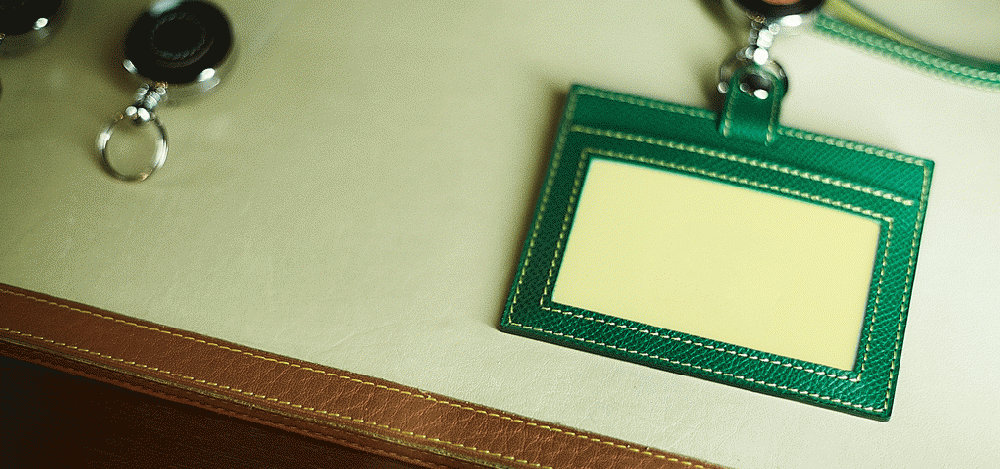
ID caseID Case
ID cases are essential items in business settings. In the wake of the events in New York on September 11, 2001,Security has been strengthened all over the world, and ID checks have become a must.
Security checks were not yet widespread in Japan, and ID cases were only simple plastic ones.
When major companies gradually started checking IDs at entrances, we started receiving requests from sensitive customers who wanted a case made of something other than plastic.
Therefore, we set out to develop a higher-grade ID case that would make you happy to wear it.
“Three roles in one”
First, when choosing a leather ID case, we assumed what kind of occasion the customer would use it for.
When I thought about various ways to use it, such as when entering the office, leaving for lunch, and returning home, I found that the best option was to be able to remove the ID itself and the strap.
At the time, contactless IC cards were beginning to become popular, and there was a demand for them as pass cases.
A pattern in which the main body and strap are jointed and worn around the neck.
A pattern where you remove the strap and attach it directly to your suit or shirt pocket.
A pattern used as a pass case,
We designed it so that it can be used in all ways.
In order to facilitate ID checks, a transparent cell window part was required.
Celluloid was selected because it was used for commuter pass holders at the time, and it had a beautiful surface.
In addition to the leather color and stitching color on the back that can be glimpsed when worn around the neck, we also carefully selected the silver parts to create the mature luster of a business person.
When I thought about various ways to use it, such as when entering the office, leaving for lunch, and returning home, I found that the best option was to be able to remove the ID itself and the strap.
At the time, contactless IC cards were beginning to become popular, and there was a demand for them as pass cases.
A pattern in which the main body and strap are jointed and worn around the neck.
A pattern where you remove the strap and attach it directly to your suit or shirt pocket.
A pattern used as a pass case,
We designed it so that it can be used in all ways.
In order to facilitate ID checks, a transparent cell window part was required.
Celluloid was selected because it was used for commuter pass holders at the time, and it had a beautiful surface.
In addition to the leather color and stitching color on the back that can be glimpsed when worn around the neck, we also carefully selected the silver parts to create the mature luster of a business person.
In the spring of 2002, the leather ID strap was announced for the first time in Japan.
In September of the same year, the product caught the attention of Japanese buyers when it was exhibited at MIPEL, an exhibition held twice a year in Milan, and famous select shops and department stores began carrying it.
However, something happened shortly after its release.
That meant that the celluloid would crack.
“The difference between New York and Japan”
Back then, when leather ID cases did not yet exist in Japan, I would go on business trips to New York two or three times a year to see what New Yorkers were actually using.
New York already has an ID system that includes an IC chip, so most people either don't use a case and hold their ID out of their pocket, or don't take it out of the plastic case. Based on the assumption that this system would spread to Japan in the future, we decided to make the window parts from celluloid.
However, at this time, many Japanese companies did not yet have the necessary facilities, and you had to show your card to the guard to enter. Since IDs were kept in the case along with commuter passes and other items, cards had to be taken in and out more frequently, putting stress on the celluloid and causing it to crack.
We provided free repairs to customers whose celluloid had cracked, but we urgently needed to think about how to improve this part.
As a result of testing materials that are resistant to cracking and resistant to bending, we decided to use vinyl chloride, which is stable against bending and stretching, has durability that resists deterioration, and also reduces oil consumption and saves resources compared to general plastics.
“Flexibility according to the times and countries”
In late 2005, as security systems became more widespread, two ID cards were required: one when entering the building and one when entering the floor.As the number of people who need it increases, we have released a model that can be used on both sides.
Furthermore, many foreign companies are adopting vertical IDs, and there is a growing demand for looking smarter with the vertical effect, so vertical IDs are also a product.
A reel can be added as an option, making the action smoother even when the case is on.
We keep up with the evolution of technology and changes in lifestyle and keep updating.
Because we live in an era where personal values are respected, we will always aim to create products that best fit our customers.
