
Have you ever had the corners of your wallet frayed?
we have experienced it.
From that experience,
“Which parts and what kind of work should I do to make a durable wallet?”
We are all working together.
It all depends on how you make it.
There are two techniques for gathering corners: ``edge polishing'' and ``heri-gaeshi.''
``Herigaeshi'' is a method of taking about 5mm longer from the front side of the pasted leather, bending it, and gluing that part.
When it comes to bending leather, it is impossible to bend it without thinning the originally thick leather. In order to make the leather thinner, the leather must be strained, which makes the thinner areas more prone to fraying.
This is the main reason why when the leather on the outside begins to age, it breaks and becomes unusable.
This method is commonly used, but since it requires fewer steps than edge polishing, it is suitable for mass production.
“Cherish good things for a long time”
We have come to the conclusion that the technique called edge polishing is the best for us as we aim to make products that can be used and loved.
Although it is a very time-consuming technique, by using this technique, it will not wear out.
What are the criteria for selection?
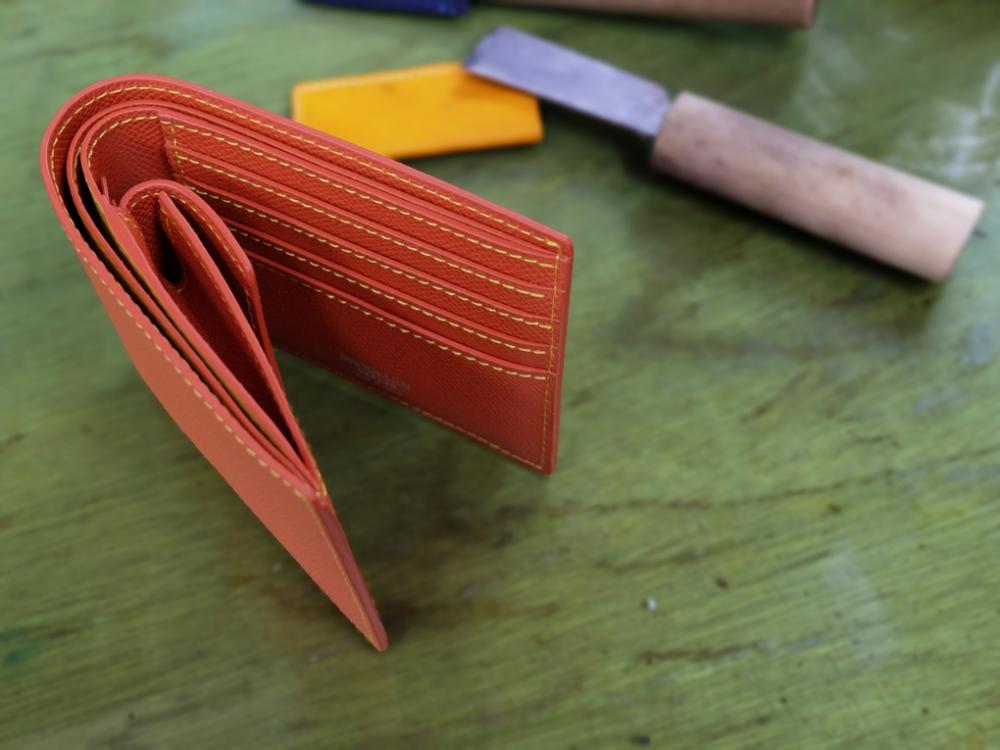
Have you ever experienced the corners of your wallet being worn out?
Carefully attach the front and back leather.
Carefully attach the front and back leather.
In order to neatly arrange the cross section of the pasted leather, we cut it to the finished size.
This is called Hondan.
In order to neatly arrange the cross section of the pasted leather, we cut it to the finished size.
This is called Hondan.
Pay attention to the front and back sides of the cut leather.
There is a saying, "Nen for Nen," and it refers to that "Nen." By applying heat with a trowel and further applying pressure, the glue penetrates into the leather and makes it difficult to peel off, and by applying extra care, it looks firmer and gives a sense of depth.
Normally, we only do the front side, but in Brooklyn we also pay special attention to the back side.
This is an important process in which we ``do our best even in the smallest areas'' so that the product becomes even stronger and can be used for a long time.
Pay attention to the front and back sides of the cut leather.
There is a saying, "Nen for Nen," and it refers to that "Nen." By applying heat with a trowel and further applying pressure, the glue penetrates into the leather and makes it difficult to peel off, and by applying extra care, it looks firmer and gives a sense of depth.
Normally, we only do the front side, but in Brooklyn we also pay special attention to the back side.
This is an important process in which we ``do our best even in the smallest areas'' so that the product becomes even stronger and can be used for a long time.
Polish the cross section of the leather that caught your attention with a file.
Then, add the dye. Once the dye has dried, sand again. By repeating this process over and over again, a beautiful edge is created. Although it is a very time-consuming process, this process is the key to ensuring that there are no holes.
Polish the cross section of the leather that caught your attention with a file.
Then, add the dye. Once the dye has dried, sand again. By repeating this process over and over again, a beautiful edge is created. Although it is a very time-consuming process, this process is the key to ensuring that there are no holes.
Another great thing about edge polishing.
That is, it can be repaired.
Instead of simply letting go of something you're attached to, you can give it a new lease of life by repairing it.
It is no exaggeration to say that each part is an "unsung hero" and supports the product.
Manufacturing in Brooklyn takes a lot of time and effort, down to the smallest detail.
Brooklyn craftsmen can't help but tinker with their craft.